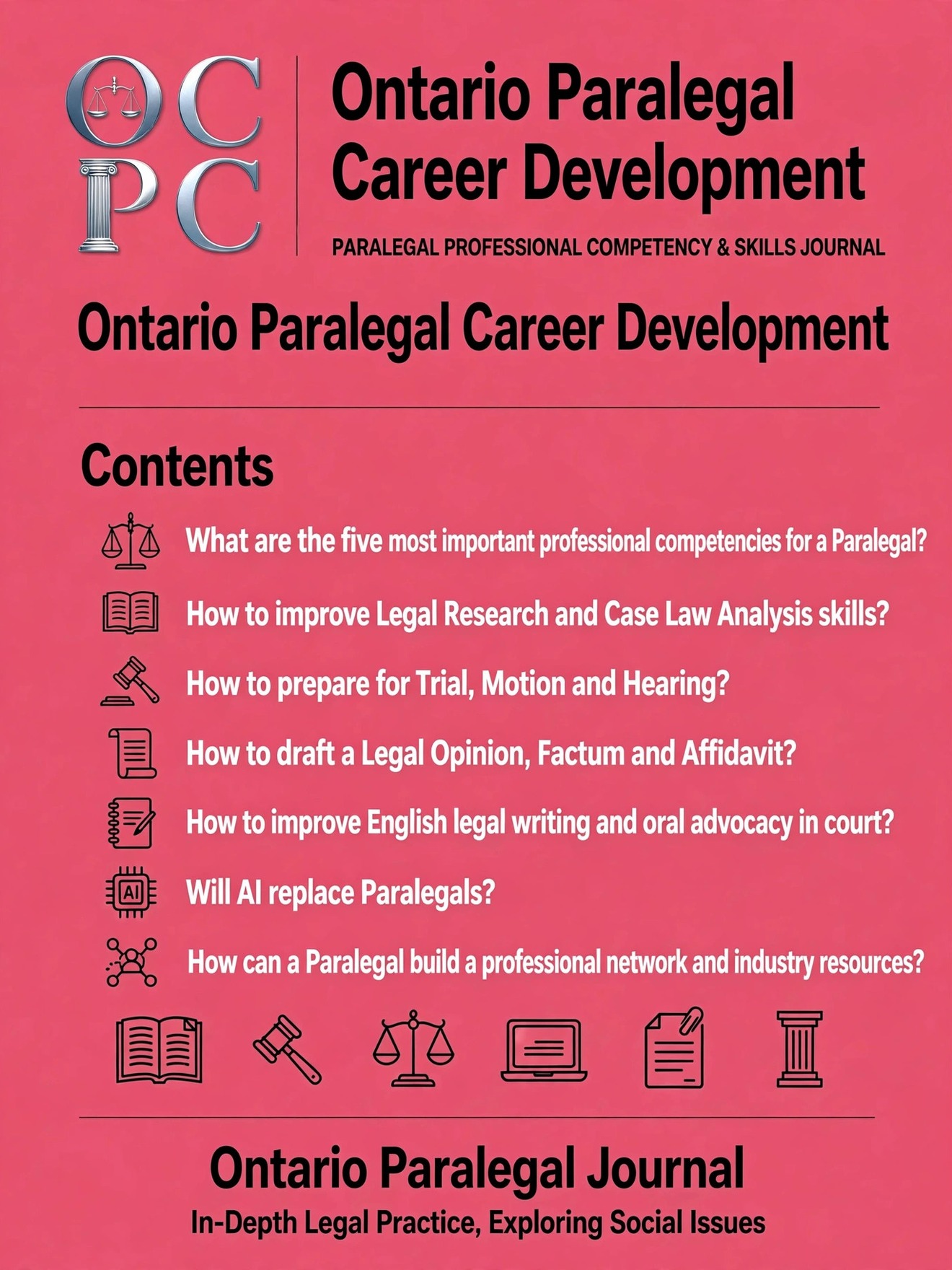
Welcome to OCPC Legal Journal · Career Development Special 01: Ontario Paralegal Career Development: Professional Competence & Skills.
This issue is for students enrolled in a Paralegal program, newly licensed practitioners, and practising Paralegals who want to sharpen their professional skills. It is built around seven questions: the five core competencies; legal research and case analysis; preparing for Trial, Motion and Hearing; drafting legal documents; legal writing and oral advocacy in English; the impact of artificial intelligence; and building a professional network.
The source material for this issue was an outline listing only the questions, with no body text. The answers in this issue were drafted by the editors from official Ontario sources (the Law Society of Ontario's Paralegal Rules of Conduct, CanLII, the Ontario court rules and others) for readers to review and verify. If anything differs from the latest official text, the official text prevails.
A Paralegal's scope of practice in Ontario is defined by the Law Society Act and the LSO rules, covering areas such as Small Claims Court, the Provincial Offences Court and administrative tribunals. This issue focuses on building competence; it does not address any individual case.
Tap any entry to jump straight to that page. Tap the right side of a page to go forward, or the left side to go back.
In Ontario, a Paralegal needs more than legal knowledge — legal research, case analysis, evidence management, litigation strategy, client communication and professional ethics all matter.
The gap between a newly graduated Paralegal and an independent practitioner often decides how fast a career advances, how good the service is, and how competitive the practice stays over the long term.
The classroom answers "what the rule is": how a statute is written, how a procedure runs, how an exam is answered. Practice asks a different set of questions: which parts of the client's story are legally relevant facts? Is the evidence enough, and where is it? How many days are left on the deadline? How will the other side respond? What does the court actually care about?
This issue breaks professional competence into modules you can practise. Each question gives workable methods, the official tools most often used, and the traps practitioners most often fall into — so you can work through them one by one and check yourself as you go.
The rules and guidance mentioned in this issue can be read free of charge on the Law Society of Ontario website (lso.ca), CanLII (canlii.org) and Ontario's e-Laws site (ontario.ca/laws).
Part One answers five questions: what the five most important professional competencies are; how to improve legal research and case analysis; how to prepare for Trial, Motion and Hearing; how to draft professional legal documents; and how to improve legal writing in English and oral advocacy in court.
The starting point of all advocacy work. Being able to locate the applicable statutes, rules and cases quickly, and to judge their force and relevance, decides the quality of every step that follows. Weak research means the documents and the hearing are built on sand.
Turning research into persuasion in the courtroom: organizing evidence, examining witnesses, answering the adjudicator's questions, and staying organized under pressure. Courtroom skill comes from preparation and review, not from improvising on the day.
The court reads the documents before it hears the submissions. A clearly structured, precisely worded document is the first professional reputation you build; communication with clients likewise needs to be written down and reviewable.
From intake assessment, the Retainer agreement and fee explanation, through progress updates to closing and file archiving. Most complaints do not come from legal ability — they come from mismatched expectations and gaps in communication. Saying clearly, and in writing, what the scope, risks, fees and next steps are is the most basic form of self-protection.
Integrity, confidentiality, conflict checks, and acting only within the scope of practice — these are the baseline requirements of the LSO Paralegal Rules of Conduct, and the source of long-term reputation. Skills can be built slowly; once credibility is damaged, it is very hard to restore.
From learning knowledge to handling cases: work in the order of a real case — facts first, then issues; evidence first, then conclusions; deadlines first, then strategy. Prepare an issues list and an evidence list for every case.
What sets excellent practitioners apart from average ones: not knowing more, but preparing more carefully, judging more steadily, and communicating more clearly; having a plan for unfavourable facts and unfavourable cases, rather than avoiding them.
Building your own edge: pick one or two practice areas to go deep in (for example Small Claims Court, landlord and tenant, or traffic tickets), and build reusable templates, checklists and a case library, so your professionalism is visible.
Check three things: whether it was appealed or overturned; whether later cases treated it negatively (overruled / distinguished); and whether the statute has since been amended so that the case's premise no longer holds. Older cases especially need this check.
| Type | Meaning and Examples |
|---|---|
| Binding Authority | A lower court or tribunal must follow it: decisions of a higher court within the same court hierarchy, such as the Supreme Court of Canada or the Court of Appeal for Ontario, bind lower courts in Ontario. |
| Persuasive Authority | It may be considered but need not be followed: decisions of courts in other provinces, courts of the same level, tribunals, and academic writing. The more similar the facts and the stronger the reasoning, the more persuasive it is. |
Read a judgment in four steps: key facts → issues → decision → the reasoning necessary to support the decision. Only the "necessary reasoning" is the ratio decidendi; a judge's passing remarks (Obiter Dicta) are only persuasive. After reading, restate the ratio in one or two sentences, then check it against the original text.
Statutory interpretation starts with the text, read together with its context and legislative purpose (the modern principle); definition clauses, exceptions and transitional provisions must be checked one by one. When applying a case to your own matter, start with a comparison of the facts: similarities support applying it, while a material difference must be actively distinguished — and you should be ready for the other side's counter-argument.
Write your theory of the case in one sentence: what we need to prove, which evidence proves it, and where the other side is weakest. Strategy decides what to leave out — evidence that has nothing to do with your theory should not go before the court, however compelling it seems.
The procedural rules differ by forum: Small Claims Court uses the Rules of the Small Claims Court (O. Reg. 258/98); civil proceedings in the Superior Court use the Rules of Civil Procedure (R.R.O. 1990, Reg. 194); each administrative tribunal has its own rules of procedure. Before a hearing, always check the latest rules and practice directions for your forum, and confirm the requirements for service and deadlines.
An Opening Statement only says "what we will prove" — no argument, no exaggeration of the evidence. Closing Submissions return to the evidence already admitted and the law, matching each issue in turn and answering the other side's strongest point head-on.
Listen to the whole question, answer it directly, then return to your point; if you do not know, say so honestly and ask to refer to a page of the file — do not guess. A question often reveals what the decision-maker is focused on; it is a chance to adjust your emphasis, not an interruption.
Every professional document shares one skeleton: facts → evidence → legal authority → argument → request. Build the skeleton before filling in the content — it is the most effective way to keep a document from becoming long and muddled.
| Document | Key Points |
|---|---|
| Legal Opinion | Issue — short answer — assumed facts — analysis — conclusion — risk notes; state clearly the range of facts relied on — if the facts change, the conclusion may change. |
| Factum | Overview, facts, issues, law and argument, and the relief sought, in that order; every paragraph of argument refers back to the page of evidence and the source of the case. |
| Affidavit | Only facts the deponent personally knows (or, where stated, the source of the information and the reason for believing it); exhibits numbered one by one and matched to the body of the text; sworn or affirmed before a Commissioner. |
Every legal point should be able to answer three questions: what is the rule (the statute or case, quoted from the original)? Where are the facts (exhibit number and page)? Why does this conclusion follow (the reasoning that applies the rule to the facts)? If any one of the three is missing, the argument does not stand.
Form numbers and names follow the Ontario court's official forms (for example, Small Claims Court forms are listed on the court forms page at ontario.ca). Before filing, check the latest version, page limits and service method; after drafting, set the document aside overnight and read it through again — the error rate drops noticeably.
Learn terms by "setting", not as isolated words: record the high-frequency terms of your practice area together with example sentences, common pairings and sources, in a personal glossary — for example, in litigation: claim / defence / damages / costs / adjournment; in landlord and tenant: arrears / termination / eviction / abatement. Reading real judgments and official forms is the most reliable source of language.
Hear the whole question before you speak; answer in complete short sentences — state the conclusion first, then add one sentence of reason; if you need to check a document, politely ask for a moment. Better too slow than too fast: if the decision-maker cannot keep up with taking notes, even the most brilliant submission loses its effect.
Questions short, single and controlled: each question locks down one fact, using statement-style leading questions to move forward; avoid arguing with the witness and avoid open-ended "why" questions — that hands the microphone to the other side.
Part Two looks at two forward-looking questions: whether artificial intelligence will replace Paralegals, and how to build your own professional network and industry resources.
The more accurate judgment is this: AI will first change how the work is done, not eliminate the profession. It is good at speed and volume — searching, summarizing, drafting first versions, tidying formats. What it does not have is responsibility to a client, honesty to the court, and professional judgment exercised within the rules — and that is exactly why the licensing system exists.
Generative AI "invents" cases that look real: the case name, the parties, the citation and even the "quoted judgment" may be fabricated. If a non-existent case is filed in court, the practitioner who filed it bears the consequences.
Iron rule: every citation must be opened and checked word for word in CanLII or an official source before it is used. Any citation that cannot be found in the original must not be used.
Client information is protected by the duty of confidentiality: do not enter information that could identify a client, or case materials, into a public AI tool that has not been assessed. The LSO has issued guidance on the use of generative AI in practice — "Generative AI: Your professional obligations" (April 10, 2024) — and the core requirement has not changed: using technology does not transfer a practitioner's responsibility. Everything filed with the court or given to a client must be something the practitioner can stand behind for accuracy. Check the LSO website for the latest guidance before using these tools.
A professional network is, at its core, long-term mutual trust: be a reliable person first — on time, as good as your word, with clean documents and clear communication — and only then talk about resources. At industry events, the goal is not how many business cards you exchange, but two or three conversations with real substance.
Working with lawyers, Paralegals and Mediators rests on a clear scope of practice: matters beyond a Paralegal's scope should be referred to a lawyer promptly, and the areas you are strong in become the reason others refer work to you. When referring, confidentiality and conflict rules apply just the same.
A placement is a student's most important entry into the profession: treat it as a long interview — take on research and drafting work, record the processes you learn, and stay in touch with your supervisor. Job applications (résumé and writing samples) should show evidence that you "can start doing the work", not a list of courses.
Joining a professional association's events, lectures and volunteer work is the shortest path to building knowledge, connections and visibility at the same time: keep showing up and keep contributing in the community, and a professional reputation forms on its own.
One, pick one practice area and build your own case and template library; two, prepare an issues list, an evidence list and a timeline for every case; three, check every citation against the original on CanLII; four, write one page of review notes after every appearance; five, attend one industry gathering each month, and review your weak spots once a quarter.
The gap in professional competence opens up in these small things, day by day.