
OCPC Ontario Chinese Paralegal Community
← Back to Legal Knowledge Centre
OCPC Law Journal
Labour & Human Rights Topic 01 · November 2026 Issue
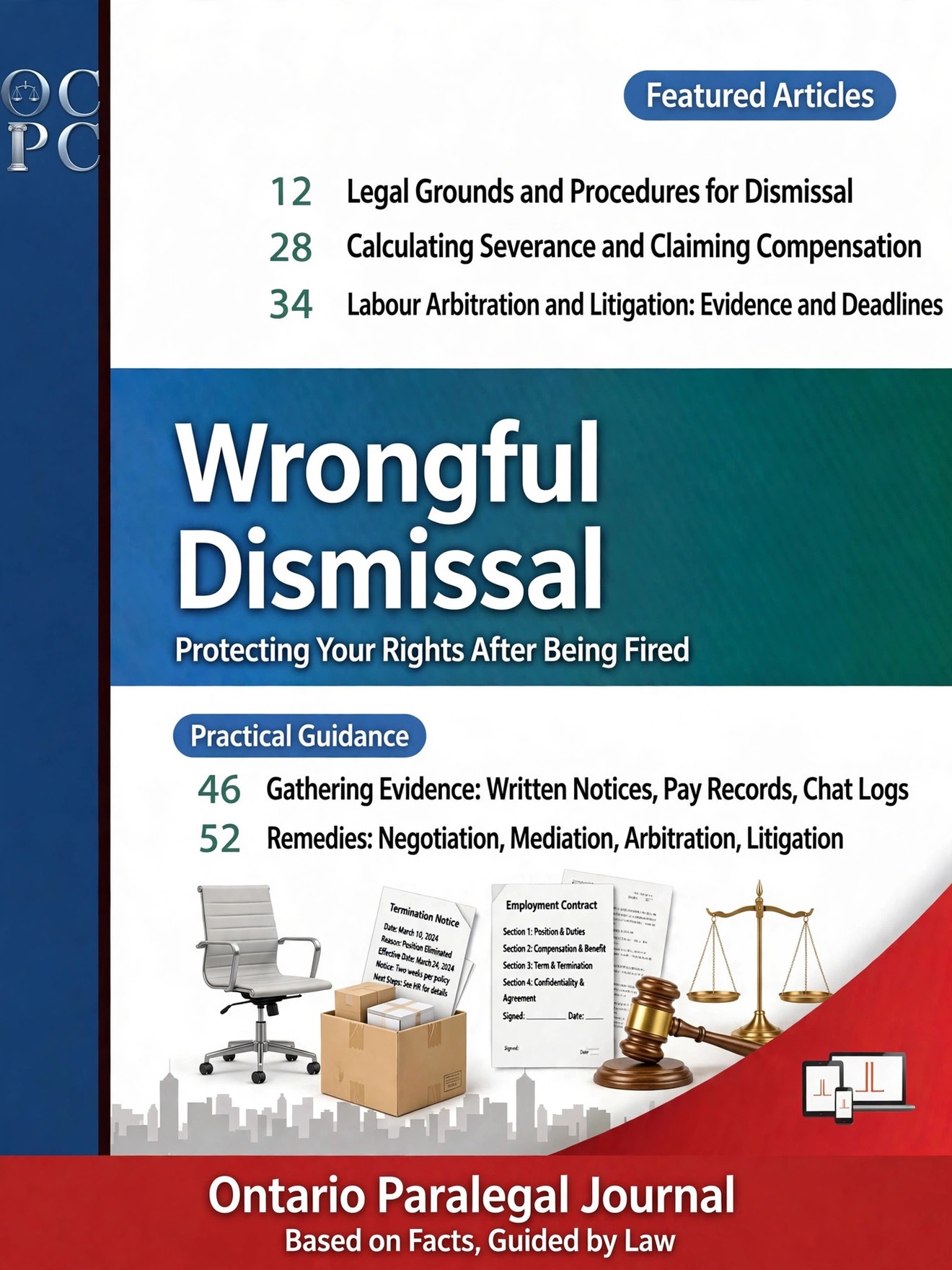
Cover of this issue: After Being Dismissed, How Do I Protect My Rights? — OCPC Law Journal · Ontario Paralegal Journal
OCPC Law Journal | Labour & Human Rights Topic 01

After Being Dismissed, How Do I Protect My Rights?

Wrongful Dismissal & Employee Rights in Ontario


In Ontario, when an employee suddenly receives a termination notice, several practical questions usually arise:

  1. Can my employer dismiss me without giving a reason?
  2. My employer only paid one or two weeks’ wages — is that lawful?
  3. I worked there for 5 years — how much compensation should I receive?
  4. I signed an Employment Termination Agreement — can I still ask for more?
  5. After being dismissed, can I apply for EI?
  6. If I believe the dismissal involved discrimination or retaliation, what should I do?
The Most Important Point

Paying the minimum termination compensation under the ESA (Employment Standards Act, 2000) does not necessarily mean the employer has met all of its legal obligations. In Ontario, an employee may be entitled both to the ESA statutory minimum and to reasonable notice or pay in lieu of notice under the common law.

November 2026 Issue · All figures in this issue have been checked by the editors against official sources.

2
Contents

Contents

Tap an item in the contents to jump straight to that section.

3
Step 01

1  |  Step 1: Identify What Kind of Dismissal This Is

Not every dismissal is an unlawful dismissal. Identify the type first — only then can you tell what your employer owes you.

1. Termination Without Cause

The employer ends the employment relationship, but not because of serious misconduct or other conduct that could justify dismissal. For example:

  • Business difficulties requiring layoffs;
  • Company restructuring that eliminates the position;
  • The employer no longer considers the employee a fit for its business needs;
  • The employer decides to replace the employee.

In most cases, an employer may dismiss an employee without cause, but it must meet the applicable notice, pay in lieu of notice, severance and other legal obligations.

2. Termination With Cause

The employer relies on the employee’s conduct or performance as the reason for dismissal. For example: serious breach of workplace discipline; fraud or serious dishonesty; serious breach of the employment contract; serious misconduct.

4
Please Note

An employer saying an employee was dismissed “for cause” does not necessarily mean just cause exists in law. The common-law threshold for just cause is usually high and depends on the seriousness of the conduct, the work context and proportionality.

3. Constructive Dismissal

The employee receives no formal termination notice, but the employer makes a major change to working conditions without consent, which may amount to constructive dismissal. For example:

  • A substantial pay cut;
  • A substantial demotion or reduction in duties;
  • A unilateral change to an important term of employment;
  • Forcing the employee to resign through a seriously unreasonable work environment.
Practical Tip

Do not hand in a resignation letter before assessing the legal risks. Once you resign voluntarily, your position for asserting your rights is completely different.

5
Step 02

2  |  Step 2: Check How Much Compensation Your Employer Should Pay

This is the part employees most need to pay attention to. In Ontario, three different concepts are involved:

AmountWhat It Means in Law
Termination PayPay in lieu of notice
Severance PayStatutory severance pay
Common Law Reasonable NoticeCommon-law reasonable notice compensation

1. ESA Statutory Minimum Notice Period

As a general rule, an employee who has worked continuously for at least 3 months is entitled, on a without-cause dismissal, to the following minimum notice based on length of service (ESA s. 57):

Length of Continuous EmploymentESA Minimum Notice
3 months to less than 1 year1 week
1 year to less than 3 years2 weeks
3 years to less than 4 years3 weeks
4 years to less than 5 years4 weeks
5 years to less than 6 years5 weeks
6 years to less than 7 years6 weeks
7 years to less than 8 years7 weeks
8 years or more8 weeks

This is the general rule; special rules and statutory exemptions may apply to certain occupations.

6

2. ESA Severance Pay

Note

Not every dismissed employee is entitled to ESA Severance Pay.

Usually both of the following must be met: you worked for the employer for at least 5 years; and —

  • The employer’s global payroll is at least $2.5 million; or
  • At least 50 employees were terminated within a six-month period because of a permanent discontinuance of all or part of the business.
Severance Pay = regular weekly wages × years of service
Partial years are calculated on a pro rata basis, up to a maximum of 26 weeks. (ESA ss. 63–65)

Severance pay and termination pay are two separate amounts: where you qualify, severance pay is paid in addition to the notice period (or pay in lieu of notice).

7

3. Common Law Reasonable Notice

This is a right many employees overlook. Even if the ESA provides for only 8 weeks’ notice, an employee may still be entitled to a longer period of reasonable notice under the common law.

The court usually considers:

  • Age
  • Length of Service
  • Character of Employment (position and responsibilities)
  • Availability of Similar Employment

These factors come from the “Bardal factors” established in Bardal v. Globe & Mail Ltd.

Important

Common-law compensation is not calculated simply as one month per year of service. Length of service alone does not determine the final amount.

Editor’s check: the original draft described Bardal as a Supreme Court of Canada judgment. On verification, the case is a 1960 decision of the Ontario Superior Court (Bardal v. Globe & Mail Ltd., 1960 CanLII 294 (ON SC)); the principle it established was later confirmed by the Supreme Court of Canada in Machtinger v. HOJ Industries and other cases. This journal has corrected the record.

8
Step 03

3  |  Step 3: Do Not Rush to Sign the Termination Agreement

After receiving a Termination Agreement or Release Agreement from your employer, check the following first:

  1. Does it ask you to give up the right to make further claims?
  2. Does it include a full and final release (Full and Final Release)?
  3. Does it pay at least the ESA statutory minimum?
  4. Does it offer any additional ex gratia payment (Ex Gratia Payment)?
  5. Does it include a confidentiality clause (Confidentiality Clause)?
  6. Does it ask you to give up claims under the Human Rights Code?
  7. Does it require you to sign within a short time?
Practical Advice

Do not sign right away just because your employer says “this is the company’s final offer.” Keep a copy of the document, ask for reasonable time to review it, and, if needed, have it reviewed by an employment lawyer or another professional with the appropriate authority to practise.

9
Step 04

4  |  Step 4: Gather Evidence and Protect Your Rights

After being dismissed, save the following right away:

Employee Rights Evidence Checklist (10 items)

  1. Employment Contract
  2. Termination Letter
  3. Pay Stubs
  4. Record of Employment (ROE)
  5. Performance Reviews
  6. Bonus / Commission Records
  7. Proof of length of service and position
  8. Relevant emails with your employer and HR
  9. Evidence of workplace discrimination, harassment or retaliation (if applicable)
  10. Termination Agreement / Release Agreement
Note

Keep only documents you are entitled to have. Do not download or take your employer’s confidential information, client information or trade secrets without authorization.

10
Step 05

5  |  Step 5: Choose the Right Complaint or Claim Route

Different disputes call for different legal processes:

Type of DisputePossible Legal Route
Unpaid wagesMinistry of Labour / ESA Claim
Unpaid overtimeESA Claim
Unpaid statutory termination compensationESA Claim
Common-law wrongful dismissalOntario Superior Court
Discrimination based on race, age or sexHRTO
Retaliation for asserting a statutory rightESA Reprisal Complaint
Unfair treatment after a workplace injuryWSIB / HRTO, depending on the issue
Union member wrongfully dismissedCollective agreement / OLRB process
11

Special Note: Discriminatory Dismissal

If you were dismissed for one of the following reasons, the Ontario Human Rights Code may apply:

Race Place of Origin Disability Sex Pregnancy Age Family Status Creed

Example: An employee asks the company for a pregnancy-related workplace accommodation and is dismissed shortly afterwards. If there is evidence linking the dismissal to the pregnancy or the accommodation request, further investigation is needed into whether this amounts to human rights discrimination.

Legal Basis

The Human Rights Code also prohibits retaliation against an employee for asserting their human rights.

12
Step 06

6  |  Step 6: Watch the Limitation Periods

Very Important

Do not let negotiations with your employer make you miss a filing deadline.

Legal ProcessGeneral Time Limit
ESA Employment Standards ClaimGenerally within 2 years of the violation (ESA s. 96(3))
HRTO human rights applicationGenerally within 1 year of the discriminatory incident (Human Rights Code s. 34)
Ordinary civil actionGenerally within 2 years of discovering the cause of action; the applicable rules need to be analyzed in each case (Limitations Act, 2002)
Special Reminder

The HRTO’s one-year deadline and the two-year civil limitation period are different. The HRTO may accept a late application only in the special circumstances set out in law (for example, where the delay was in good faith and caused no substantial prejudice).

13
Step 07

7  |  What to Do After Being Dismissed: A Practical Order of Steps

  1. Same day: Keep the termination notice — Do not rush to sign a Release Agreement. Keep your contract, pay stubs and dismissal-related emails.
  2. Within 1–3 days: Check your compensation — Verify Termination Pay, Severance Pay, Vacation Pay, Bonus and Benefits.
  3. As soon as possible: Check your contract — Confirm whether the Termination Clause is valid and whether you may be entitled to Common Law Reasonable Notice.
  4. As soon as possible: Assess whether anything unlawful happened — Consider whether discrimination, retaliation, a breach of the ESA or Constructive Dismissal may be involved.
  5. In time: Choose the legal process — Depending on the nature of the case, consider an ESA Claim, an HRTO Application or a Wrongful Dismissal Action.
  6. At the same time: Apply for EI — If you qualify, you can apply for Employment Insurance through Service Canada. Do not wait indefinitely just because you have not yet received your ROE.
14
Summary

8  |  Journal Summary: The Five Things Employees Should Remember Most

  1. Receiving a termination notice does not mean your employer has already met all of its legal obligations.
  2. The ESA minimum compensation is not necessarily equal to common-law reasonable compensation.
  3. Do not sign a Release Agreement without understanding it.
  4. Keep your contract, pay stubs, termination notice and related evidence.
  5. Watch the separate time limits for the HRTO, the ESA and civil actions.
Core Legal Principle

Employees are entitled to require their employer to comply with the Employment Standards Act, 2000, the Human Rights Code, the applicable employment contract and common-law obligations.

15
Resources

9  |  Official Legal Resources

The following are guides and procedural information published by Ontario official bodies. You can find them on Ontario.ca and the relevant agencies’ websites:

Ontario
Termination of Employment
Ontario
Severance Pay
Ontario
Filing an Employment Standards Claim
HRTO
Application and Hearing Process
Ontario Human Rights Commission
Employment

This article is for general legal knowledge and public education only. It is not legal advice about any individual case. OCPC provides community exchange, legal education and resource information services. It does not replace a lawyer or a licensed Paralegal giving legal advice about an individual case. Every case is different — consult a professional with the appropriate qualifications for your own situation.

16
About This Issue

About This Issue

“After Being Dismissed, How Do I Protect My Rights?” is OCPC Law Journal’s Labour & Human Rights Topic 01. It walks through six steps after a dismissal in Ontario: identifying the type of dismissal, checking compensation, reviewing the termination agreement, gathering evidence, choosing a claim route, and watching the limitation periods.

The key figures in this issue have been checked by the editors against official sources: the ESA s. 57 notice-period table, severance eligibility and the 26-week cap under ss. 63–65, the 2-year ESA claim period (s. 96(3)), the 1-year HRTO application period (Human Rights Code s. 34), and the 2-year basic civil limitation period (Limitations Act, 2002).

Editor’s Correction

The original draft described the Bardal factors for common-law reasonable notice as coming “from a Supreme Court of Canada judgment in Bardal v. Globe & Mail.” On verification, Bardal is a 1960 decision of the Ontario Superior Court; the principle was later confirmed by the Supreme Court of Canada. This journal has corrected the record (see page 8). All other figures are unchanged from the original draft.

Edited and published by OCPC Law Journal · Ontario Chinese Paralegal Community (OCPC).

17
✉  Email Us ☎  Call Us

OCPC provides general legal information, not legal advice.

18

Tap the right side of the book to turn to the next page, or the left side to go back. You can also jump from the contents page or the buttons below. The left and right arrow keys work too.